Image Settings
Understand Ideogram aspect ratio, resolution, image count, quality, Magic Prompt, seed and background settings, including what changes when you switch models.On this page
Each model in the Image app shows only the settings it supports. You can generate with the defaults and change a setting when the result needs it. Settings marked as being under Advanced settings sit in a collapsed row near the bottom of the panel; select it to open.
What changes when I switch models?
The Image app shares your prompt between models and carries over your image-count choice. It carries over an aspect ratio only when the destination model supports that shape. Other options, such as a style preset or quality choice, belong to the individual model. Check its panel after switching rather than assuming every setting transferred.
These are working drafts in the current app session, not a promise that settings will follow you after a reload or onto another device. For a completed run, use Recreate to restore the supported inputs and settings.
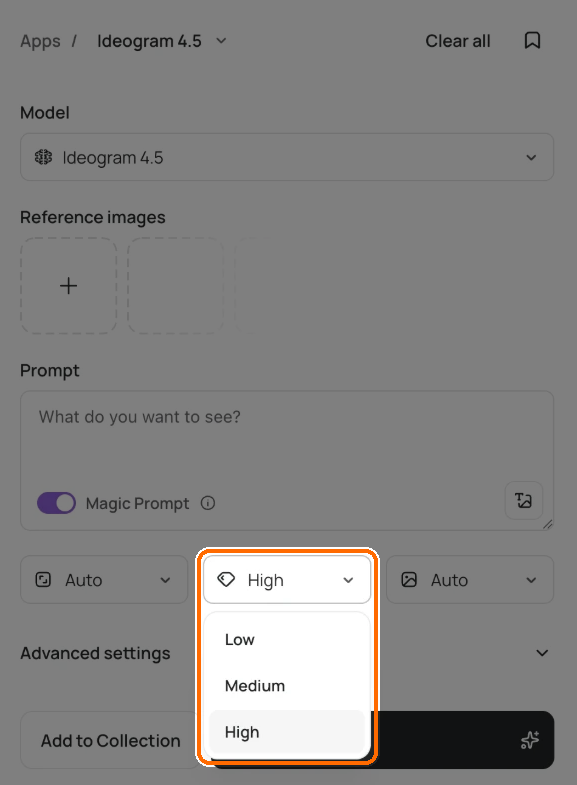
Each model shows only its own settings. Here, Ideogram 4.5 offers Low, Medium and High quality.
Aspect ratio and size
Aspect ratio sets the shape of the image. On some models a Resolution menu appears after you pick a ratio, with labels such as "1K (1024 × 1024)" or "2K (2048 × 2048)".
| Model | Aspect ratios | Default |
|---|---|---|
| Auto | Auto, 1:1, 4:3, 3:4, 3:2, 2:3, 16:9, 9:16 | Auto |
| Ideogram 4.5 | Auto, or a ratio from the Square, Landscape and Portrait groups, then Resolution 1K or 2K | Auto |
| Ideogram 4.0 | Auto, or 1:1, 5:4, 4:3, 3:2, 8:5, 16:9, 2:1, 12:5, 22:9, 23:9, 8:3, 3:1 and their portrait mirrors, then Resolution 1K or 2K | Auto |
| Ideogram 3.0 | 1:1, 4:5, 5:4, 3:4, 4:3, 2:3, 3:2, 10:16, 16:10, 9:16, 16:9, 1:2, 2:1, 1:3, 3:1. No Auto and no Resolution menu | 1:1 |
On Ideogram 4.0, the widest ratios (12:5, 22:9, 23:9, 8:3 and their mirrors) come in 2K only. Ideogram 4.5 offers the same ratios, but 3:1 and 1:3 also come in 2K only.
Common shapes: 1:1 for profile pictures, logos and stickers; 4:5 for Instagram and Facebook feed posts; 9:16 for Instagram Stories, Reels, TikTok and YouTube Shorts; 16:9 for YouTube thumbnails and presentations; 2:3 for Pinterest pins, posters and book covers; 3:1 for banners and website headers.
The Transparent and partner models have their own lists; see Models.
Why can't I see Resolution?
On Ideogram 4.0 and 4.5, the Resolution choice appears after you select a fixed aspect ratio. While the ratio is Auto, the model decides the output shape and that separate menu is hidden. On Ideogram 4.5 with reference images, Size replaces both controls.
Size on Ideogram 4.5 with reference images
When you attach reference images to Ideogram 4.5, a Size menu replaces Aspect ratio and Resolution:
- Auto: "Picks a size from your images and prompt."
- Source image size: "Keeps the first image's own width and height."
- Custom: enter Width and Height. Each side must be a multiple of 32 and at least 256 px. The total area can't exceed 4,194,304 pixels (2048 × 2048), and the aspect ratio can't exceed 6:1 or 1:6.
The area limit is different from a 2048-pixel limit on each side. For example, 3072 × 1024 is within the area limit and has a 3:1 ratio. Invalid dimensions must be corrected before generating. Use Source image size when retaining the first reference's dimensions is your aim.
Number of images
Choose Auto or 1 to 8 images per run. More images cost more credits, and the Generate button shows the total. Every image model has this setting, and Auto is the default. On the Auto model, your last choice is kept for next time.
What Auto gives you depends on the model:
- Auto model: 4 images, or 2 when you attach references
- Ideogram models and P-Image-Ideogram: 4
- GPT Image, Nano Banana and Z-Image: 1
Quality
Quality trades speed and cost against detail. The cost on the Generate button changes with your choice.
| Model | Options | Default on paid plans |
|---|---|---|
| Ideogram 4.5 | Very low, Low, Medium, High. Very low appears only when you attach reference images | High |
| Ideogram 4.0, 3.0 and both Transparent models | Turbo, Default, Quality | Default |
| GPT Image 2.5 | Auto, Low, Medium, High | Auto |
| P-Image-Ideogram | Very Low, Low, Medium, High | Medium |
On a free plan, Ideogram models start at the cheapest option: Turbo, or Low on Ideogram 4.5. Auto and the other partner models have no Quality setting.
Magic Prompt
Magic Prompt "Enhances your prompt to improve image variety and richness. It can also translate your prompt into English." It's an on/off toggle, and it starts on. Turn it off when you want the model to follow your exact words.
Magic Prompt appears on Ideogram 4.5, 4.0, 3.0 and 3.0 Transparent. On Ideogram 4.5 it hides when you attach reference images, because the prompt then works as an edit instruction. Ideogram 4.0 Transparent has Prompt upsampling (Auto, On or Off) under Advanced settings instead. Auto and the partner models have no Magic Prompt; P-Image-Ideogram has its own Prompt upsampling switch under Advanced settings.
Ideogram 4.5 and 4.0 also accept JSON prompts. See JSON Prompting.
Take the prompt Photo of cupcake and strawberries. Magic Prompt expanded it into a longer prompt that added frosting, sprinkles and a rustic, sunlit background:
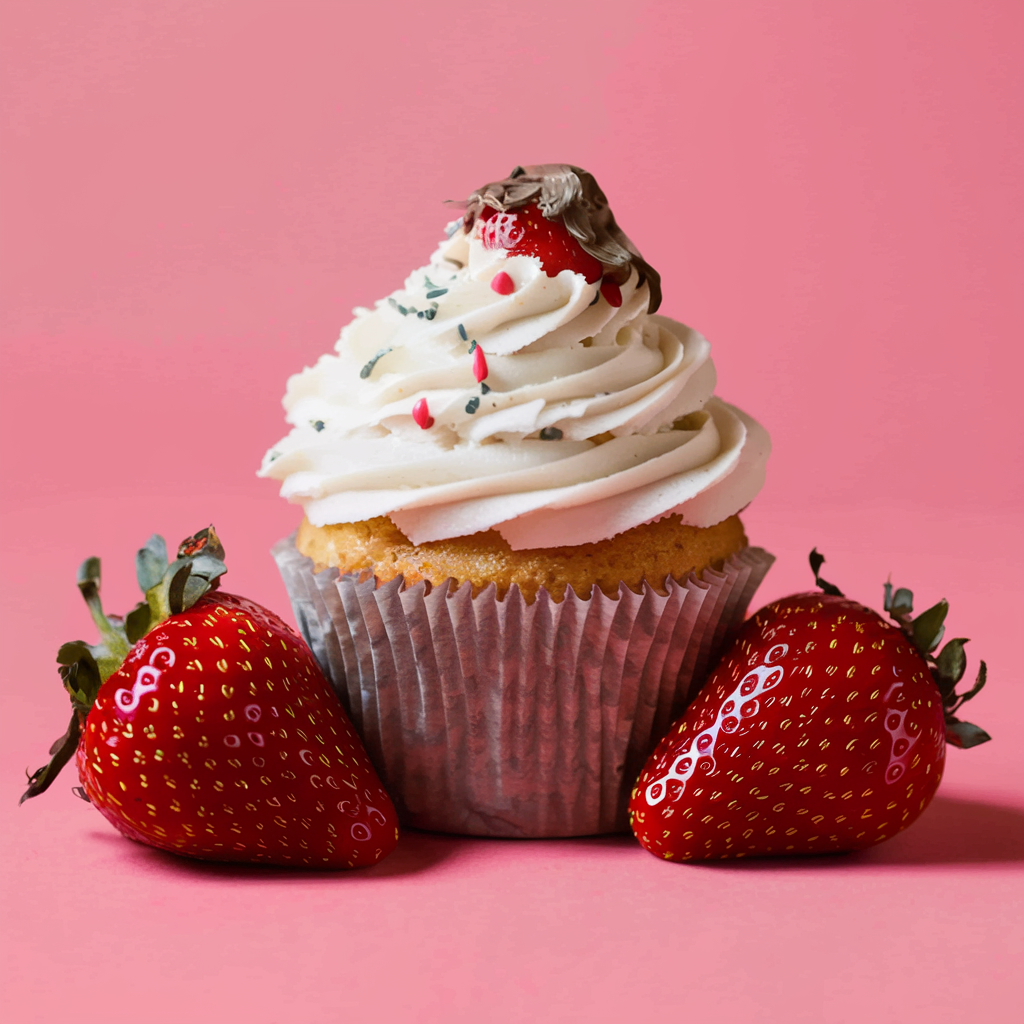
Magic Prompt off.
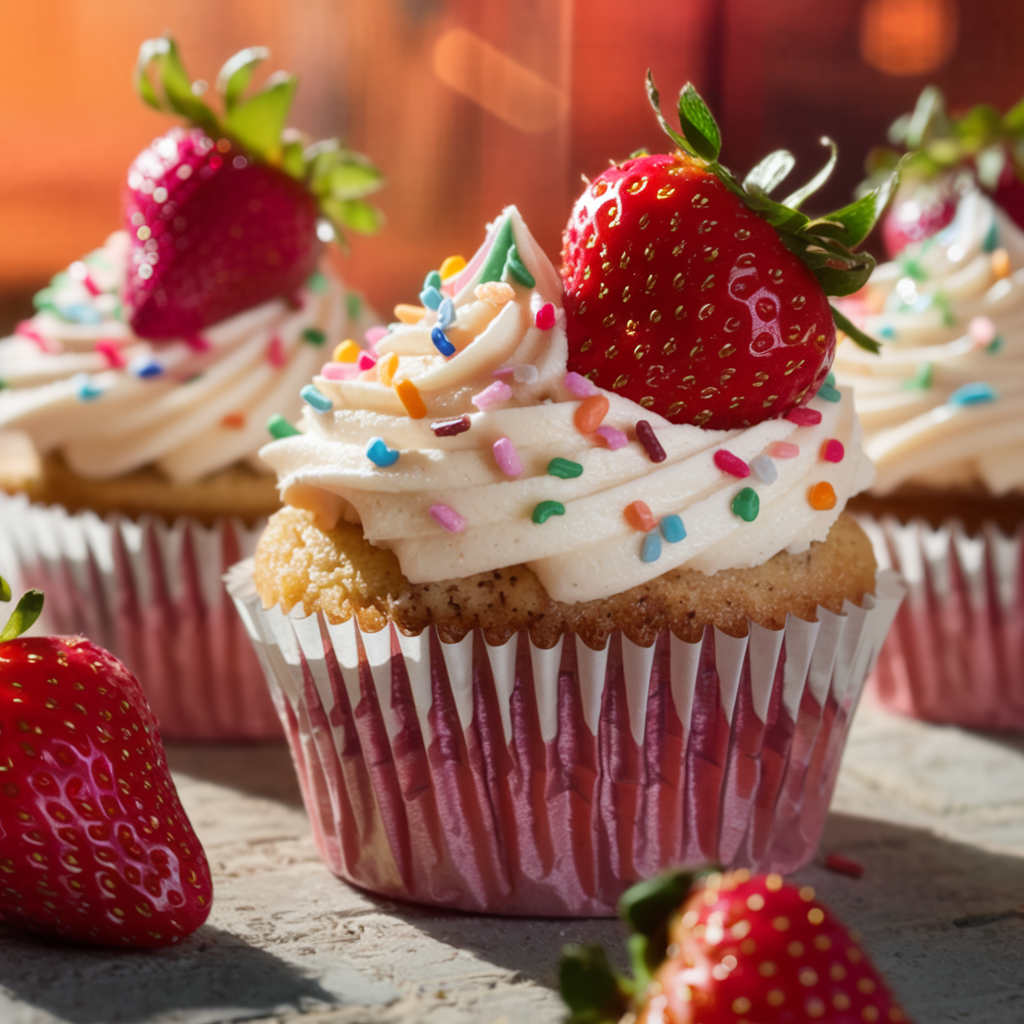
Magic Prompt on.
Background
On Ideogram 4.5 and GPT Image 2.5, open Advanced settings to find Background:
- Auto (default): leaves the background choice to the model.
- Transparent: keeps an alpha channel, so the result can have a clear background.
- Opaque: fills the background in.
This setting works with or without reference images. Download as PNG or WEBP to keep transparency. Ideogram 4.0 and 3.0 use separate Transparent models instead. See Transparent Backgrounds.
Seed
The seed is the number a run starts from. Keep the seed, model and settings fixed when comparing prompt changes so you change fewer inputs at once. A seed isn't a saved copy of an image and doesn't guarantee identical output or layout.
Find Seed under Advanced settings on every image model. The field shows "Random" when empty, which means each run gets a new seed.
Set a seed
- Open Advanced settings.
- Enter digits only in Seed, up to 2147483647.
To fill in a random seed instead, select the dice button (New random seed).
The dice button fills in one specific number. That number stays in the field for subsequent runs until you change or clear it. To request a fresh random seed on every run, clear the field so it reads Random again. A matching seed alone doesn't guarantee identical output across different models or settings.
Switching models, or changing a key idea in the prompt (say, "photo" to "painting"), gives a different image even with the same seed.
Collection
Add to Collection saves every image from your next runs into a collection. Every image model has this setting, and no collection is picked by default.
Save new images to a collection
- Select Add to Collection.
- Choose a collection. The button then shows the collection's name.
To stop saving to it, select the x on the button.
There's no public/private setting in the Image app. On Plus, Pro, Team and Enterprise, new images stay private until you publish one. On the free plan and the legacy Basic plan, everything you generate is public. To publish an image:
- Open the image.
- Select More options.
- Select Manage.
- Select Publish to community.
Ideogram 3.0 settings
These settings appear on Ideogram 3.0, under Advanced settings. Custom models built on Ideogram 3.0 have them too, except the Style menu. Custom models built on another available base use that base's controls instead.
Negative prompt
Negative prompt ("Things to avoid") lists what you don't want in the image. Separate items with commas, for example green, green candies. The field has its own Describe button.
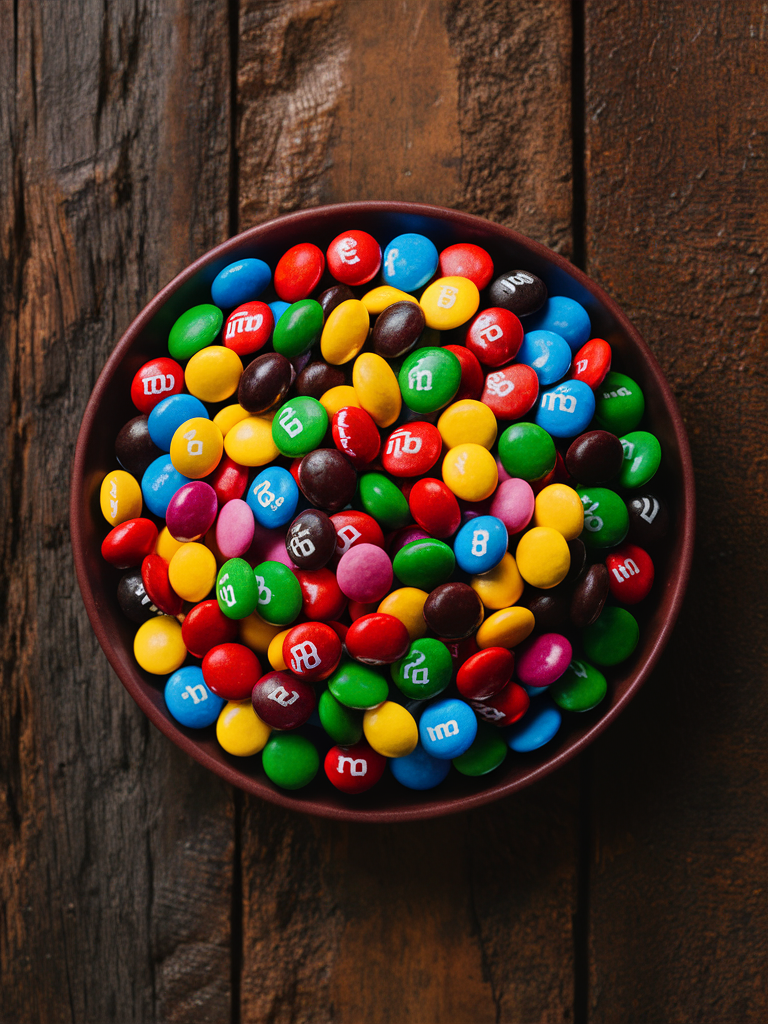
No negative prompt.
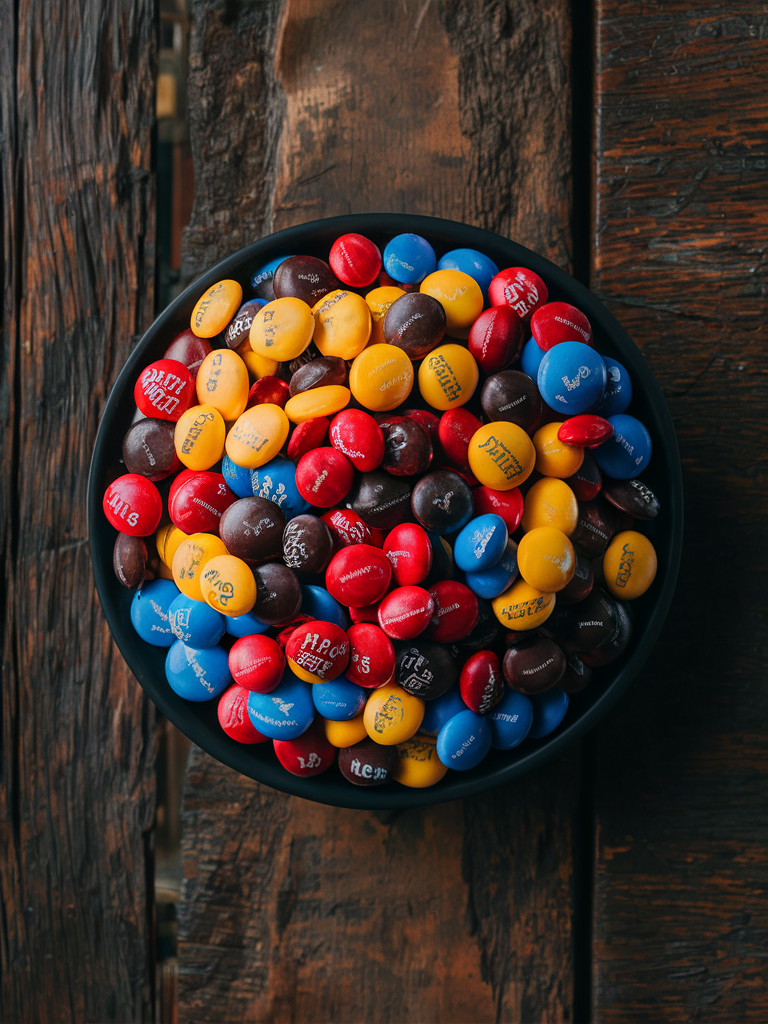
Negative prompt: green, green color, green candies.
Avoid contradicting the main prompt with the negative prompt. If you ask for a classical guitar, strings can still appear even when you list them as something to avoid. Try a positive description of what should be visible instead. See Fix Common Problems.
Style
Three controls shape the look of an Ideogram 3.0 image.
Style sets the overall type:
- Auto (default): picks a style from your prompt
- General: fits most uses, including art and abstract work
- Realistic: lifelike photos with true colors, textures and light
- Design: clean, vector-like images such as logos and posters
Style preset opens Style presets: "Distinct, prescriptive aesthetics that define the image's look even with short prompts." Choose None or one of 62 presets.
Style reference images take up to 10 of your own images and copy their look. See Style Reference for the steps, limits and what to use on other models.
Presets and style reference images work only with the Auto or General style; with Realistic or Design you'll see "Available with the Auto or General style." You can use a preset or style references, not both: "Style references replace the style preset."
Apply a style preset
- Choose Ideogram 3.0 in the Model picker.
- Open Advanced settings.
- Set Style to Auto or General.
- Select Style preset to open Style presets.
- Choose a preset.
Add style reference images
The steps are on Style Reference.
For a preset or style references to come through clearly, turn Magic Prompt off and keep style words out of your prompt. Short prompts work best.
Color palette
Color palette steers the colors of the image. Treat it as a direction, not an exact color match; it works best alongside color words in your prompt.
Choose None, a preset (Ember, Fresh, Jungle, Magic, Melon, Mosaic, Pastel or Ultramarine) or Custom.
Custom palettes need a Plus, Pro, Team or Enterprise plan. On other plans the option shows as Custom (Plus) and can't be picked.
Use a custom palette
- Choose Ideogram 3.0 in the Model picker.
- Open Advanced settings.
- Set Color palette to Custom. A Palette colors field appears.
- Type up to 8 hex codes in Palette colors, separated by spaces, such as
#FF5733 #0133FF #DE3357.
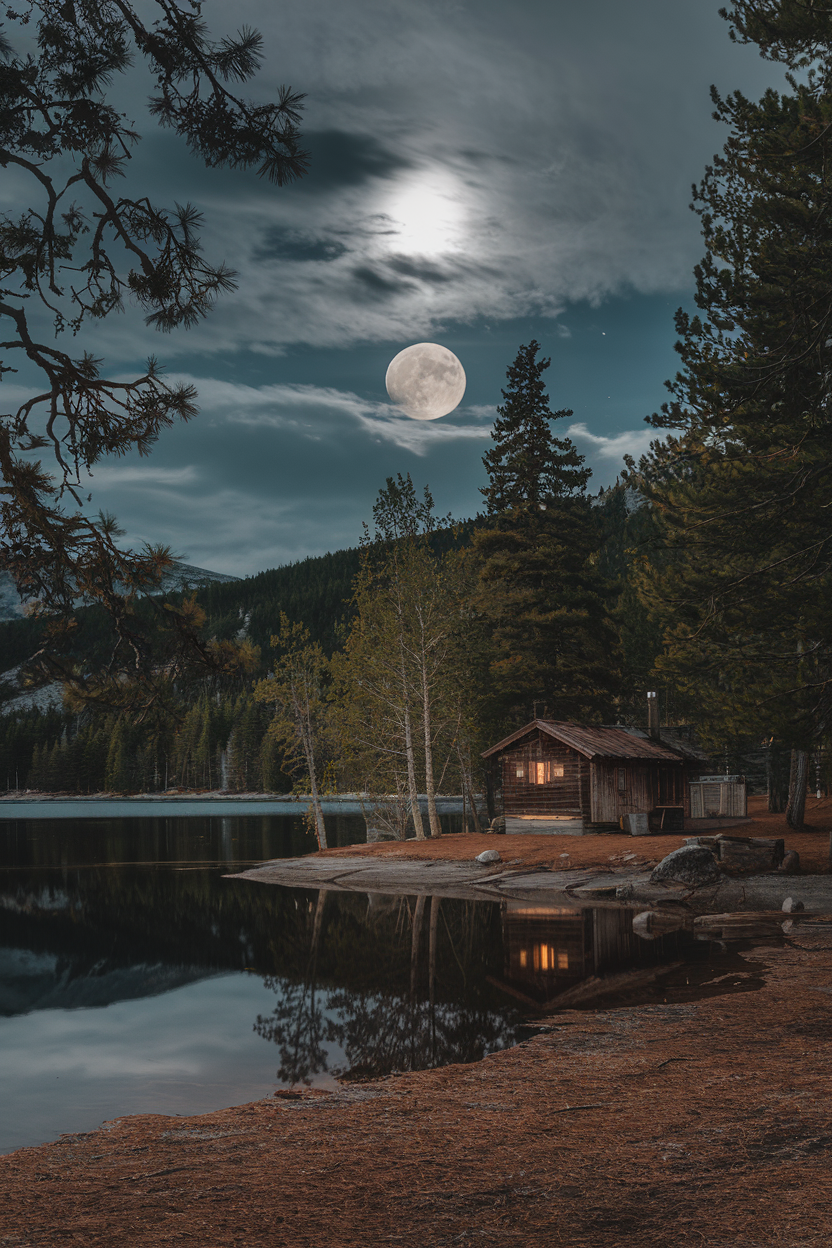
No palette.
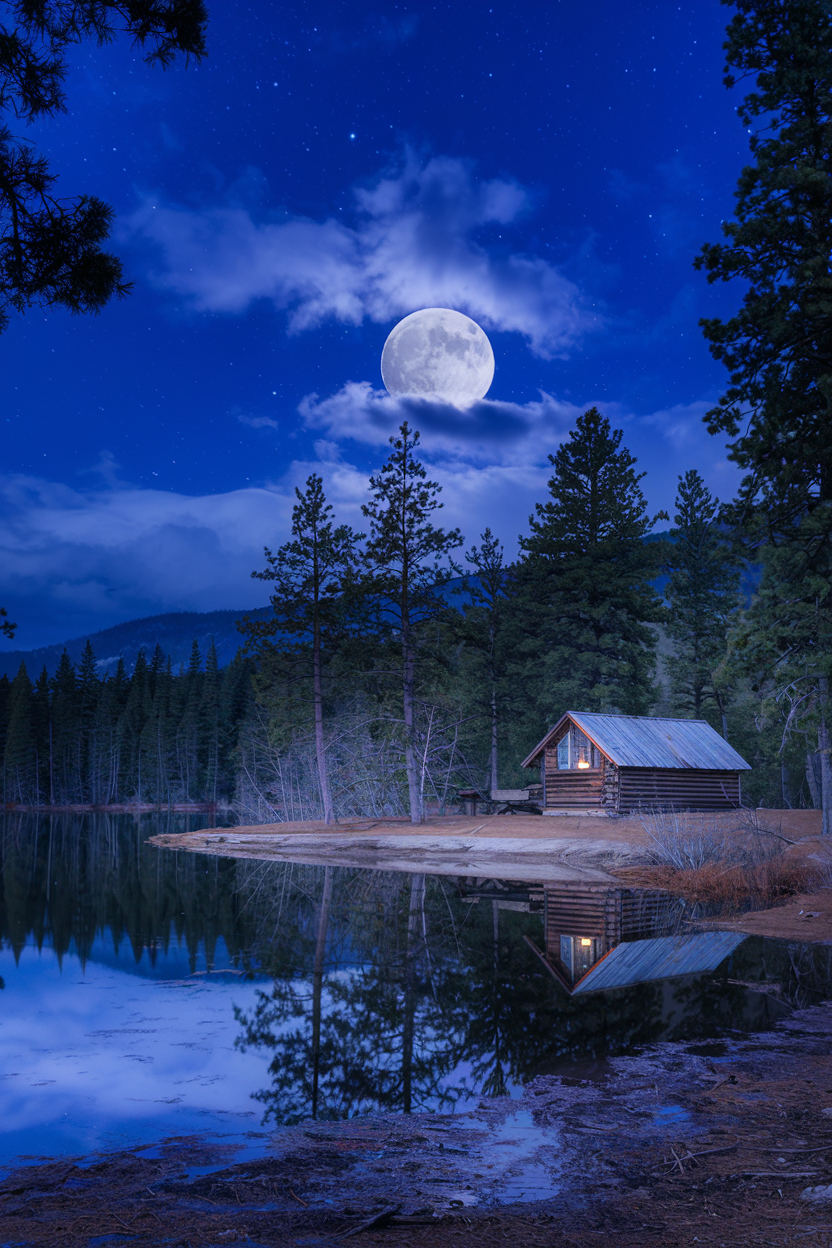
Ultramarine.
In this topic: creating images
- Create Images: make your first image
- Models: pick the model for the job
- Image Settings (this page): set size, quality and other options
- Prompting Basics: write a prompt that works
- Fix Common Problems: fix results that come out wrong
Each setting has a matching request field on the model's endpoint, such as num_images, seed and magic_prompt. See Generate with Ideogram 4.5.