> For the complete documentation index, see [llms.txt](https://docs.ideogram.ai/llms.txt). Markdown versions of documentation pages are available by appending `.md` to page URLs; this page is available as [Markdown](https://docs.ideogram.ai/using-ideogram/ui-overview/ui-components/details-panel.md).
# Details Panel
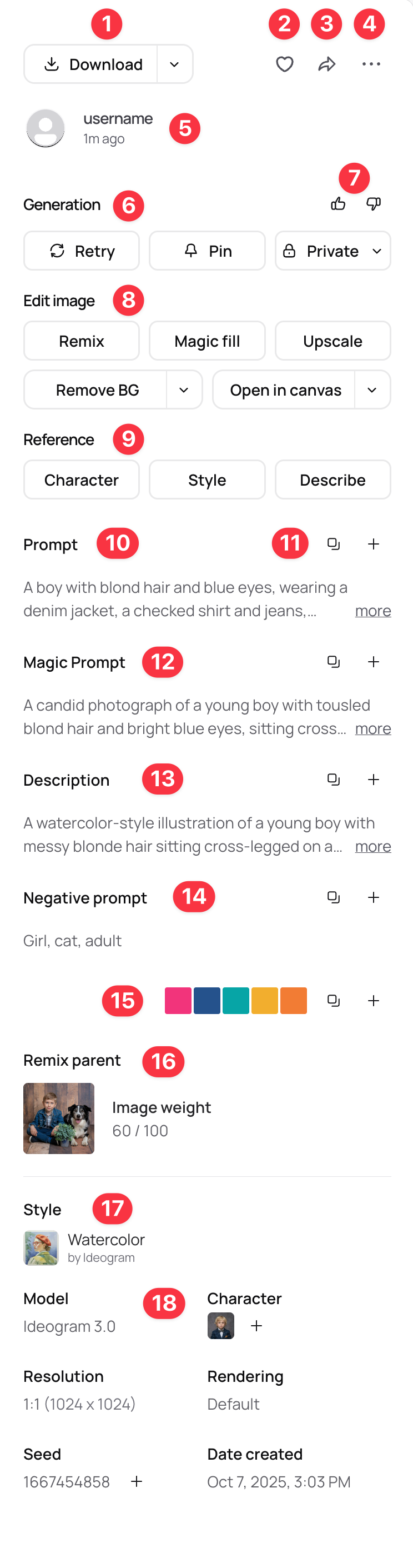
The Details panel appears on the right (desktops computers and large tablets) or bottom (devices such as smartphones) when viewing a single image. It provides all generation information, including prompts, model settings, and available actions.
1. **Download** – Download the image to your device or computer.
2. **Like** – Click to add a like. Also shows the number of people who liked the image.
3. **Share** – Share the image on a website or social network of your choice.
4. **More** – Displays the [More menu](/using-ideogram/ui-overview/ui-components/more-menu-....md) containing several additional options.
5. **Username & Creation** – Creator’s username and profile picture, a link to their profile, and the time when the image was generated.
6. **Generation** – (This section is visible only for your images)
1. **Retry** – Generate the image again with the same or adjusted settings.
2. **Pin / Unpin** – Keep or remove the image from the top of your profile.
3. **Private / Public** – Make the image visible only to you or to everyone.
7. **Rate Generation** (visible only for your images) – Provide feedback on the quality of the result.
8. **Edit Image** – Fast access to the most popular editing features:
1. **Remix** – Create a new image variation starting from this one.
2. **Magic Fill** – Replace or fill areas of the image using AI.
3. **Upscale** – Increase the image resolution up to 2×.
4. **Remove Background** – Remove the background around the main subject. Click the dropdown menu to replace the background instead.
5. **Open in Canvas** – Launch the image in the advanced editing workspace.
9. **Reference** – Use the image as reference for your next generation:
1. **Character** – Use the image as a character reference.
2. **Style** – Use the image as a style reference.
3. **Describe** – Generate a text description of the image.
10. **Prompt** – The original prompt as it was written in the prompt box before clicking Generate.
11. **Copy /** **Use** – Copy or use the prompt or setting in your next generation. Also available for other settings described below.
12. **Magic Prompt** – The Magic Prompt text if the image was generated with that feature.
13. **Description** – The text prompt that was generated if you used Describe on the image.
14. **Negative Prompt** – The text used as the negative prompt.
15. **Color Palette** – The color palette used when generating the image.
16. **Parent Image** – The parent image used when the generation was a Remix or an Upscale.
17. **Style** – The style used to generate the image. It can be a generic or a custom one.
18. **Other Information** – In this section, you will see various details such as the **Model** and Character **Reference** used to generate the image, the **dimensions** and **aspect ratio**, the **Rendering speed**, the **Seed number**, and the **date and time** the image was created.